The short answer
T-bone (side-impact) collisions often cause serious injuries at intersections. Liability usually turns on who had the right-of-way. Under California law, a driver who runs a red light or stop sign is typically at fault. Gather police reports, traffic-camera footage, and witness statements, and speak to a lawyer before accepting any settlement.
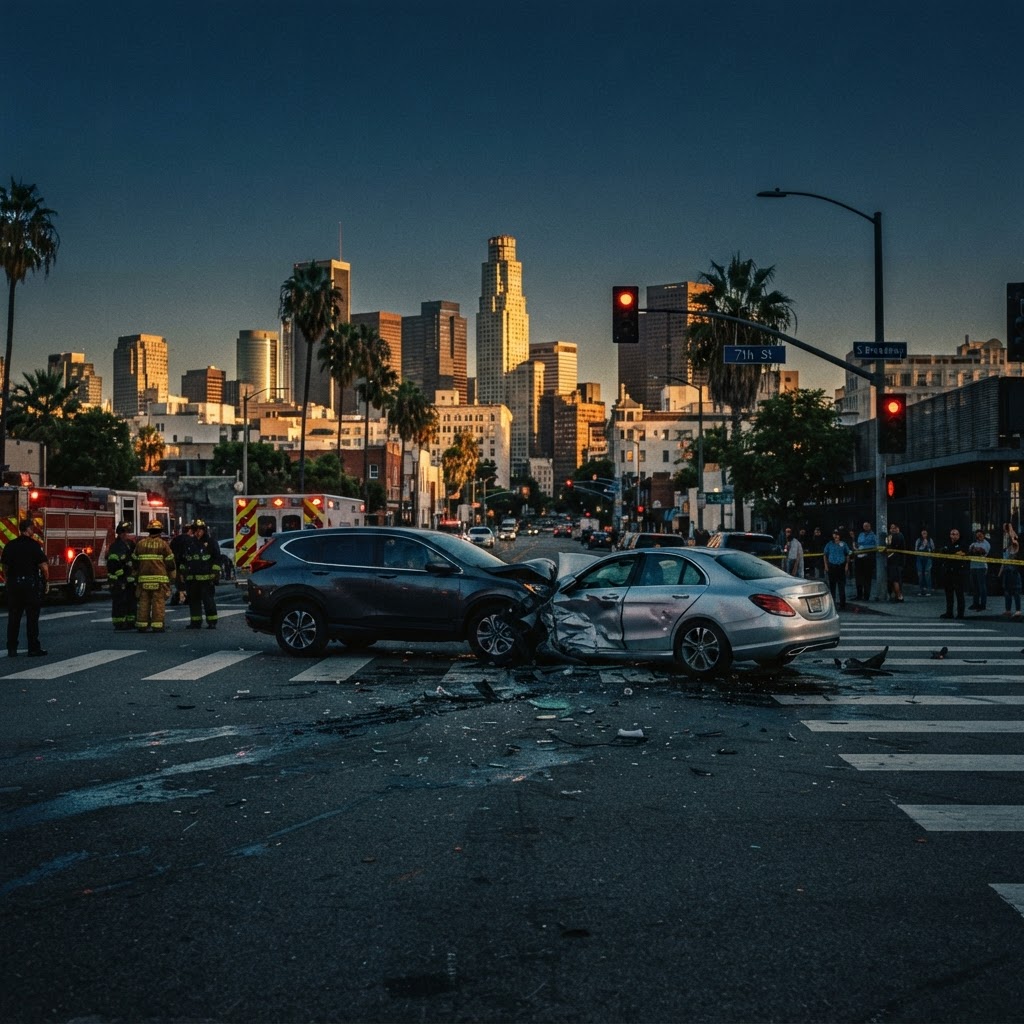
A T-bone collision happens when the front of one vehicle strikes the side of another, usually in an intersection. There is only a door and a window between you and the other car, so these crashes often cause fractures, head injuries, and internal trauma that a front or rear impact might not. In Los Angeles, where drivers race yellow lights at intersections like Wilshire and Western or Sunset and Vermont, side-impact crashes are a constant risk.
Unlike many rear-end cases, fault in a T-bone crash is frequently disputed. Each driver may say their light was green. Witnesses disagree. Camera footage from nearby businesses may be recorded over within days. When Our founding attorney has fought insurers for injured Californians since 2002. We move early so that does not happen to you.
We look at signal timing, sight lines, vehicle damage patterns, speed, and the position of each car at rest. If the crash involved a malfunctioning signal, an obstructed view, or a poorly designed intersection, a public entity may share responsibility, which triggers a short six-month claim deadline. Understanding every possible source of liability protects the value of your claim.
Your consultation is free, and you pay no attorney's fee unless we recover compensation for you. If you were struck broadside in Los Angeles, call us so we can start preserving intersection evidence right away.
From the other side of the table
How the insurer's adjuster sees a T-bone claim
Competing green-light stories
When both drivers claim the right-of-way, adjusters often default to shared fault. We pursue traffic camera footage, business surveillance video, signal-timing information, and independent witnesses to break the tie with evidence.
Speed allegations against you
Even if the other driver ran a red light, the insurer may claim you were speeding and could have avoided the crash. Vehicle event data and scene measurements can show your actual speed and response time.
The 'you entered on yellow' argument
Adjusters sometimes argue that entering on a late yellow shares fault. California law allows entering on yellow, and we examine signal timing to show whether you were lawfully in the intersection.
Discounting serious injuries as pre-existing
Side impacts often cause shoulder, hip, and spinal injuries that insurers try to attribute to age or earlier conditions. We work with treating physicians to connect the injury pattern to the side-impact forces involved.
Why it happens
Common causes
Running red lights
Drivers trying to beat the light at major intersections along Figueroa, Western, Vermont, and La Cienega frequently strike cross traffic that has just received a green.
Unprotected left turns
A driver turning left across oncoming traffic without a green arrow must yield. Misjudging the gap is one of the most common causes of broadside crashes in LA.
Rolling through stop signs
In residential neighborhoods from Silver Lake to the San Fernando Valley, drivers who treat stop signs as optional cause side-impact collisions at otherwise quiet corners.
Blocked sight lines
Parked trucks, overgrown landscaping, and building corners can hide approaching cars, especially at intersections without signals.
Exiting driveways and parking lots
Drivers pulling out of strip malls and gas stations onto busy boulevards often misjudge the speed of approaching traffic.
Malfunctioning signals
Signals that are dark, stuck, or poorly timed can cause confusion about right-of-way and may create public-entity liability.
What we see
Injuries we handle
What you may recover
Compensation in a California claim
Medical and rehabilitation costs
Emergency care, surgery, hospital stays, rehabilitation, home health care, and future medical treatment related to serious side-impact injuries.
Lost earnings and earning capacity
Income lost during recovery and reduced ability to work if your injuries leave lasting physical limitations.
Pain and suffering
Physical pain, emotional distress, anxiety at intersections, and loss of enjoyment of activities you can no longer do the same way.
Household and personal help
The reasonable value of help you need with household tasks, transportation, and personal care while you recover.
Property losses
Vehicle repair or replacement, rental car costs, and damaged personal property inside the car.
The rules that apply
California law you should know
Red light means stop
A driver facing a steady red signal must stop and may not enter the intersection until the signal allows, except for permitted turns after stopping.
Vehicle Code § 21453
Left-turning drivers must yield
A driver turning left must yield to approaching traffic that is close enough to constitute a hazard.
Vehicle Code § 21801
Stop sign right-of-way
A driver approaching a stop sign must stop and yield to vehicles that have entered or are approaching the intersection closely enough to be a hazard.
Vehicle Code § 21802
Government claim deadline
If a dangerous intersection or malfunctioning signal contributed to the crash, a written claim against the responsible public entity generally must be presented within six months.
Government Code § 911.2
General information, not legal advice. Deadlines and rules depend on the facts of your case, so talk to an attorney promptly.
Right now
Protect your claim
Evidence to gather
- Photos showing where each vehicle came to rest
- Photos of the signals, signs, and any obstructions at the intersection
- Addresses of businesses with cameras facing the intersection
- Names and contact information for independent witnesses
- The police report, including any diagrams and witness statements
- Your vehicle and its event data, preserved before repair or salvage
- Medical records, imaging, and surgical reports
- Records of time missed from work
Mistakes insurers count on
- Assuming the police report settles fault without gathering independent evidence
- Waiting weeks to ask nearby businesses for surveillance video
- Allowing your car to be salvaged before its data and damage are documented
- Apologizing at the scene in a way that can be read as admitting fault
- Overlooking a possible claim against a city or county for a dangerous intersection
Step by step
How we handle your case
- 1
Immediate evidence requests
We act quickly to request intersection and business video, since many systems overwrite recordings within days.
- 2
Scene and signal investigation
We review the intersection layout, signal phases, sight lines, and road conditions, and we identify any public-entity involvement.
- 3
Vehicle data and damage analysis
Where appropriate, we preserve vehicle event data and work with accident reconstruction professionals to establish speeds and positions.
- 4
Damages documentation
We gather complete medical records, bills, and work records to show the full scope of your injuries and losses.
- 5
Resolution strategy
We negotiate with the carrier using the evidence we have built, and we are prepared to file suit when a fair resolution is not offered.
From the Case Vault
Related results
Past results do not guarantee a similar outcome. Every case is different and must be evaluated on its own facts.
Straight answers
Frequently asked questions
Fault usually falls on the driver who failed to yield the right-of-way, such as a driver who ran a red light, rolled through a stop sign, or turned left in front of oncoming traffic. But fault can be shared, and insurers frequently argue that the other driver was speeding or inattentive. The answer depends on evidence like video, signal timing, witness accounts, and vehicle damage patterns.
Vehicle Accidents